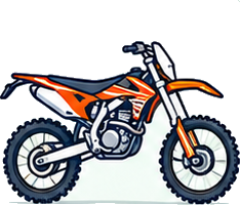
Enduro / offroad

Enduro / offroad Motorcycles

Enduro and off-road motorcycles were engineered to venture where regular street bikes cannot survive. Originating from multi-day reliability trials in the mid-20th century, this class strips away non-essential bodywork to focus entirely on lightness, structural resilience, and traction over unpredictable terrain. Whether navigating forest single-tracks, muddy bogs, or open desert stretches, these machines are built to endure harsh mechanical punishment.

Design, Ergonomics, and Active Riding Posture

The architecture of an off-road bike serves a purely functional purpose:

  • Tall and Flat Seat Profile: With seat heights commonly exceeding 900 mm, the narrow and seamless seat allows the rider to slide effortlessly forward and backward to balance weight.
  • Wide, Elevated Handlebars: Positioned to provide leverage when standing on the serrated footpegs, ensuring precise steering input over rocks and ruts.
  • Durable, Pliable Bodywork: High-impact plastics and reinforced aluminum skid plates withstand frequent drops and flying debris without structural compromise.

Who Should Choose an Off-Road Motorcycle?

This category appeals to riders who view motorcycling as an athletic, adventurous activity rather than simple highway transit. It is particularly rewarding for those wanting to master fundamental motorcycle control, including precise clutch modulation, low-speed balance, and line selection on loose surfaces. While race-bred two-strokes and lightweight four-strokes cater to seasoned trail enthusiasts, milder dual-sport derivatives offer an approachable gateway for novices looking to transition between asphalt and trail.

Core Technical Characteristics of the Category

  • Long-Travel Suspension: Offering 250 mm to over 300 mm of travel, damping systems soak up heavy landings, roots, and deep craters.
  • Large Spoke Wheels with Knobby Tires: A 21-inch front wheel paired with an 18-inch rear wire-spoked wheel rolls over obstacles smoothly while aggressive tire treads bite into soil.
  • Ultra-Lightweight Construction: Dry weights typically range between 100 kg and 140 kg, making the bike manageable when stuck or dropped.
  • Torque-Biased Single-Cylinder Engines: Tuned for strong low-to-mid range torque, delivering predictable tractive power at low crawling speeds.

What to Look for When Choosing an Enduro Bike

Riders must evaluate their maintenance willingness before purchasing. Dedicated competition enduros measure service intervals in operational engine hours and require frequent fluid and piston changes, whereas street-legal dual-sport models feature standard mileage intervals. Seat height ergonomics must be checked against rider confidence, and buyers should verify whether the model includes lighting, mirrors, and road registration eligibility.

Who Should Look Elsewhere?

These machines are entirely unsuited for long-distance highway touring, sustained high speeds, or two-up passenger travel. The minimal wind protection, narrow saddle, and buzz from single-cylinder engines cause rapid fatigue on straight tarmac. Commuters seeking weather protection, luggage space, and low-vibration cruising will be far better served by standard road or adventure-touring categories.

Enduro / offroad Motorcycle Models

1,699 Enduro / offroad motorcycles listed

GAS GAS Enduro / offroad 2011
  • Engine
    Single cylinder two-stroke
  • Power
  • Displacement
    297 cc
  • Bore/Stroke
    72.5mm / 72.5mm
GAS GAS Enduro / offroad 2011
  • Engine
    Single cylinder two-stroke
  • Power
  • Displacement
    297 cc
  • Bore/Stroke
    72.5mm / 72.5mm
GAS GAS Enduro / offroad 2011
  • Engine
    Single cylinder four-stroke
  • Power
  • Displacement
    249 cc
  • Bore/Stroke
    66.4mm / 72.0mm
GAS GAS Enduro / offroad 2011
  • Engine
    Single cylinder two-stroke
  • Power
  • Displacement
    249 cc
  • Bore/Stroke
    66.4mm / 72.0mm
GAS GAS Enduro / offroad 2011
  • Engine
    Single cylinder two-stroke
  • Power
  • Displacement
    249 cc
  • Bore/Stroke
    66.4mm / 72.0mm
GAS GAS Enduro / offroad 2011
  • Engine
    Single cylinder two-stroke
  • Power
  • Displacement
    249 cc
  • Bore/Stroke
    66.4mm / 72.0mm
GAS GAS Enduro / offroad 2011
  • Engine
    Single cylinder two-stroke
  • Power
  • Displacement
    199 cc
  • Bore/Stroke
    62.5mm / 65.0mm
GAS GAS Enduro / offroad 2011
  • Engine
    Single cylinder two-stroke
  • Power
  • Displacement
    124 cc
  • Bore/Stroke
    54.0mm / 54.5mm
GAS GAS Enduro / offroad 2011
  • Engine
    Single cylinder two-stroke
  • Power
  • Displacement
    124 cc
  • Bore/Stroke
    54.0mm / 54.5mm
2011 Derbi Senda DRD 125 R Motorcycle A1 Derbi Enduro / offroad 2011
  • Engine
    Single cylinder four-stroke
  • Power
    15.0 hp (11.0 kW)
  • Displacement
    124 cc
  • Bore/Stroke
    58.0mm / 47.0mm
A2 CCM Enduro / offroad 2011
  • Engine
    Single cylinder four-stroke
  • Power
    18.0 hp (13.2 kW)
  • Displacement
    230 cc
  • Bore/Stroke
    67.0mm / 65.0mm
2011 BMW G 450 X Motorcycle A2 BMW Enduro / offroad 2011
  • Engine
    Single cylinder four-stroke
  • Power
    40.2 hp (29.6 kW)
  • Displacement
    450 cc
  • Bore/Stroke
    98.0mm / 59.6mm
A1 Blata Enduro / offroad 2011
  • Engine
    Single cylinder four-stroke
  • Power
    13.4 hp (9.9 kW)
  • Displacement
    124 cc
  • Bore/Stroke
Beta Enduro / offroad 2011
  • Engine
    Single cylinder four-stroke
  • Power
  • Displacement
    124 cc
  • Bore/Stroke
    54.0mm / 54.0mm
Beta Enduro / offroad 2011
  • Engine
    Single cylinder four-stroke
  • Power
  • Displacement
    349 cc
  • Bore/Stroke
    88.0mm / 57.4mm
A Benelli Enduro / offroad 2011
  • Engine
    Single cylinder four-stroke
  • Power
    59.7 hp (43.9 kW)
  • Displacement
    505 cc
  • Bore/Stroke
    104.0mm / 59.5mm
A2 Yuki Enduro / offroad 2010
  • Engine
    Single cylinder four-stroke
  • Power
    16.8 hp (12.3 kW)
  • Displacement
    249 cc
  • Bore/Stroke
    72.0mm / 61.2mm
Yuki Enduro / offroad 2010
  • Engine
    Single cylinder four-stroke
  • Power
  • Displacement
    124 cc
  • Bore/Stroke
A1 Xmotos Enduro / offroad 2010
  • Engine
    Single cylinder four-stroke
  • Power
    8.7 hp (6.4 kW)
  • Displacement
    120 cc
  • Bore/Stroke
    52.4mm / 55.5mm
A1 Xmotos Enduro / offroad 2010
  • Engine
    Single cylinder four-stroke
  • Power
    8.7 hp (6.4 kW)
  • Displacement
    120 cc
  • Bore/Stroke
    52.4mm / 55.5mm
AM Xispa Enduro / offroad 2010
  • Engine
    Single cylinder four-stroke
  • Power
    4.6 hp (3.3 kW)
  • Displacement
    50 cc
  • Bore/Stroke
AM Xispa Enduro / offroad 2010
  • Engine
    Single cylinder four-stroke
  • Power
    4.6 hp (3.3 kW)
  • Displacement
    50 cc
  • Bore/Stroke
A2 Vuka Enduro / offroad 2010
  • Engine
    Single cylinder four-stroke
  • Power
    14.5 hp (10.7 kW)
  • Displacement
    198 cc
  • Bore/Stroke
    69.0mm / 53.0mm
A1 Vuka Enduro / offroad 2010
  • Engine
    Single cylinder four-stroke
  • Power
    11.1 hp (8.2 kW)
  • Displacement
    124 cc
  • Bore/Stroke
    56.5mm / 49.1mm
UM Enduro / offroad 2010
  • Engine
    Single cylinder four-stroke
  • Power
  • Displacement
    150 cc
  • Bore/Stroke
UM Enduro / offroad 2010
  • Engine
    Single cylinder four-stroke
  • Power
  • Displacement
    150 cc
  • Bore/Stroke
    64.0mm / 49.7mm
UM Enduro / offroad 2010
  • Engine
    Single cylinder four-stroke
  • Power
  • Displacement
    125 cc
  • Bore/Stroke
    56.0mm / 49.7mm
2010 Triumph Tiger Motorcycle A Triumph Enduro / offroad 2010
  • Engine
    In-line three four-stroke
  • Power
    114.0 hp (83.8 kW)
  • Displacement
    1,050 cc
  • Bore/Stroke
    79.0mm / 71.4mm
2010 Track T-800 CDI Motorcycle A Track Enduro / offroad 2010
  • Engine
    Diesel Diesel
  • Power
    53.6 hp (39.5 kW)
  • Displacement
    800 cc
  • Bore/Stroke
AM Tomos Enduro / offroad 2010
  • Engine
    Single cylinder two-stroke
  • Power
    2.4 hp (1.7 kW)
  • Displacement
    49 cc
  • Bore/Stroke
    38.0mm / 43.0mm
## What Defines an Enduro and Off-Road Motorcycle? Enduro and off-road motorcycles were engineered to venture where regular street bikes cannot survive. Originating from multi-day reliability trials in the mid-20th century, this class strips away non-essential bodywork to focus entirely on lightness, structural resilience, and traction over unpredictable terrain. Whether navigating forest single-tracks, muddy bogs, or open desert stretches, these machines are built to endure harsh mechanical punishment. ## Design, Ergonomics, and Active Riding Posture The architecture of an off-road bike serves a purely functional purpose: - **Tall and Flat Seat Profile:** With seat heights commonly exceeding 900 mm, the narrow and seamless seat allows the rider to slide effortlessly forward and backward to balance weight. - **Wide, Elevated Handlebars:** Positioned to provide leverage when standing on the serrated footpegs, ensuring precise steering input over rocks and ruts. - **Durable, Pliable Bodywork:** High-impact plastics and reinforced aluminum skid plates withstand frequent drops and flying debris without structural compromise. ## Who Should Choose an Off-Road Motorcycle? This category appeals to riders who view motorcycling as an athletic, adventurous activity rather than simple highway transit. It is particularly rewarding for those wanting to master fundamental motorcycle control, including precise clutch modulation, low-speed balance, and line selection on loose surfaces. While race-bred two-strokes and lightweight four-strokes cater to seasoned trail enthusiasts, milder dual-sport derivatives offer an approachable gateway for novices looking to transition between asphalt and trail. ## Core Technical Characteristics of the Category - **Long-Travel Suspension:** Offering 250 mm to over 300 mm of travel, damping systems soak up heavy landings, roots, and deep craters. - **Large Spoke Wheels with Knobby Tires:** A 21-inch front wheel paired with an 18-inch rear wire-spoked wheel rolls over obstacles smoothly while aggressive tire treads bite into soil. - **Ultra-Lightweight Construction:** Dry weights typically range between 100 kg and 140 kg, making the bike manageable when stuck or dropped. - **Torque-Biased Single-Cylinder Engines:** Tuned for strong low-to-mid range torque, delivering predictable tractive power at low crawling speeds. ## What to Look for When Choosing an Enduro Bike Riders must evaluate their maintenance willingness before purchasing. Dedicated competition enduros measure service intervals in operational engine hours and require frequent fluid and piston changes, whereas street-legal dual-sport models feature standard mileage intervals. Seat height ergonomics must be checked against rider confidence, and buyers should verify whether the model includes lighting, mirrors, and road registration eligibility. ## Who Should Look Elsewhere? These machines are entirely unsuited for long-distance highway touring, sustained high speeds, or two-up passenger travel. The minimal wind protection, narrow saddle, and buzz from single-cylinder engines cause rapid fatigue on straight tarmac. Commuters seeking weather protection, luggage space, and low-vibration cruising will be far better served by standard road or adventure-touring categories.

Frequently Asked Questions

What is the Enduro / Off-road category?

It is a motorcycle class specifically engineered to handle unpaved dirt trails, rocks, and mud through lightweight chassis design, tall ground clearance, and long-travel suspension.

Who should choose an Enduro / Off-road motorcycle?

Riders seeking active outdoor exploration, technical off-tarmac challenges, and machines focused on agile handling and low-speed obstacle control.

What are the standout features of Enduro / Off-road motorcycles?

Key traits include large 21-inch front spoked wheels, knobby tires, suspension travel exceeding 250 mm, and a flat, narrow profile optimized for stand-up riding.

Is it suitable for beginners / what should they watch out for?

Mild dual-sport models are beginner-friendly, but tall seat heights can intimidate newer riders when stopping, and the lack of wind protection makes highway cruising uncomfortable.