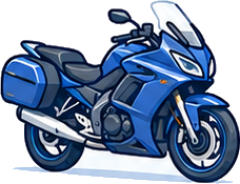
Sport Touring

Sport Touring Motorcycles

The Sport Touring category emerged out of a genuine necessity: riders wanted the exhilarating power and razor-sharp handling of a sports bike without the punishing physical toll on multi-day journeys. Pure superbikes force aggressive body angles that fatigue the wrists and lower back, while full-dress touring cruisers often sacrifice agile cornering for plush size. Sport Tourers strike an intentional middle ground, delivering crisp chassis response, ample ground clearance, and sustained highway stability designed for cross-country routes.

Ergonomic Profile and Aerodynamic Design

Form follows function in this class, centering around superior wind management and all-day cockpit comfort. Expansive fairings channel turbulent air away from the rider's chest and shoulders, often aided by electronically adjustable windscreens. The rider triangle is significantly more upright than on supersport machines; clip-ons or handlebars sit higher, and footpegs are placed in a neutral position that keeps knees relaxed. Deeply padded, broad seats are standard, ensuring that both rider and passenger can log extended saddle time without soreness.

Rider Profile and Experience Level

This category draws seasoned motorcyclists who value flexibility and speed over extreme specialization. The typical Sport Touring owner includes:

  • Enthusiasts who enjoy spirited riding on mountain passes and sweeping backroads.
  • Long-haul travelers who pack hard luggage and cross several state or national borders in a single run.
  • Riders carrying a regular passenger who demands adequate seating, grab handles, and smooth power delivery.
  • Commuters facing long highway stretches who require weather protection and generous storage.

Core Characteristics of the Segment

Despite varying engine architectures, bikes in this segment share foundational hardware:

  • Robust Powertrains: Mid-to-large displacement engines tuned for broad, linear midrange torque rather than peak high-rpm scream.
  • Integrated Luggage Systems: Hard panniers and top cases seamlessly contoured to the bike's frame without upsetting high-speed balance.
  • Long-Range Capacity: Large fuel tanks (routinely between 19 and 25 liters) providing substantial range between stops.
  • Comprehensive Electronics: Cruise control, lean-sensitive traction control, cornering ABS, and adjustable engine maps.
  • Reinforced Subframes: Engineered chassis capable of handling heavy payloads, including luggage and a pillion, without flexing.

Key Buying Considerations

When evaluating a Sport Tourer, wet weight and seat height are critical parameters. Fully loaded with gear and fuel, these motorcycles demand confident low-speed balance and firm footing at stops. Check the adjustability of the windscreen to ensure it redirects airflow cleanly over your helmet without causing buffeting. Suspension quality is equally vital: models offering electronic damping adjustment or easily accessible preload knobs make transitioning from solo track-style riding to two-up touring seamless.

Who Should Look Elsewhere?

Sport Touring motorcycles are not universal tools. They are generally too heavy, wide, and warm for tight inner-city gridlock where lightweight scooters or nakeds excel. They lack the long-travel suspension, spoked wheels, and ground clearance required for unpaved trails and off-road exploration. Finally, their substantial mass and high power output make them intimidating and unforgiving for absolute novices learning basic clutch and balance controls.

Sport Touring Motorcycle Models

233 Sport Touring motorcycles listed

2026 Bajaj Dominar 400 Motorcycle A2 Bajaj Sport Touring 2026
  • Engine
  • Power
    40.0 hp (29.4 kW)
  • Displacement
    373 cc
  • Bore/Stroke
2026 Triumph Tiger Sport 800 Motorcycle A Triumph Sport Touring 2026
  • Engine
  • Power
    113.0 hp (83.1 kW)
  • Displacement
    798 cc
  • Bore/Stroke
2026 Honda NT1100 Motorcycle A Honda Sport Touring 2026
  • Engine
  • Power
    102.0 hp (75.0 kW)
  • Displacement
    1,084 cc
  • Bore/Stroke
2025 Yamaha FJR1300AE Motorcycle A Yamaha Sport Touring 2025
  • Engine
  • Power
    144.2 hp (106.0 kW)
  • Displacement
    1,298 cc
  • Bore/Stroke
A SWM Sport Touring 2025
  • Engine
    Single cylinder four-stroke
  • Power
    53.6 hp (39.5 kW)
  • Displacement
    600 cc
  • Bore/Stroke
A SWM Sport Touring 2025
  • Engine
  • Power
    53.6 hp (39.5 kW)
  • Displacement
    600 cc
  • Bore/Stroke
Suzuki Sport Touring 2025
  • Engine
    In-line four four-stroke
  • Power
  • Displacement
    1,000 cc
  • Bore/Stroke
2025 Suzuki GSX-S1000GT Motorcycle A Suzuki Sport Touring 2025
  • Engine
    In-line four four-stroke
  • Power
    152.0 hp (111.8 kW)
  • Displacement
    999 cc
  • Bore/Stroke
A1 Macbor Sport Touring 2025
  • Engine
    Single cylinder four-stroke
  • Power
    12.5 hp (9.2 kW)
  • Displacement
    125 cc
  • Bore/Stroke
A Kawasaki Sport Touring 2025
  • Engine
  • Power
    133.0 hp (97.8 kW)
  • Displacement
    1,099 cc
  • Bore/Stroke
A Kawasaki Sport Touring 2025
  • Engine
    In-line four four-stroke
  • Power
    133.0 hp (97.8 kW)
  • Displacement
    1,099 cc
  • Bore/Stroke
A Kawasaki Sport Touring 2025
  • Engine
    In-line four four-stroke
  • Power
    133.0 hp (97.8 kW)
  • Displacement
    1,099 cc
  • Bore/Stroke
Kawasaki Sport Touring 2025
  • Engine
    In-line four four-stroke
  • Power
  • Displacement
    1,099 cc
  • Bore/Stroke
A Kawasaki Sport Touring 2025
  • Engine
    In-line four four-stroke
  • Power
    207.0 hp (152.2 kW)
  • Displacement
    998 cc
  • Bore/Stroke
Kawasaki Sport Touring 2025
  • Engine
    In-line four four-stroke
  • Power
  • Displacement
    1,099 cc
  • Bore/Stroke
2025 Kawasaki Ninja 1100SX SE Motorcycle A Kawasaki Sport Touring 2025
  • Engine
    In-line four four-stroke
  • Power
    134.0 hp (98.6 kW)
  • Displacement
    1,099 cc
  • Bore/Stroke
A2 Jonway Sport Touring 2025
  • Engine
    V2 four-stroke
  • Power
    23.1 hp (17.0 kW)
  • Displacement
    242 cc
  • Bore/Stroke
2025 Husqvarna Norden 901 Motorcycle A Husqvarna Sport Touring 2025
  • Engine
    Twin four-stroke
  • Power
    103.3 hp (76.0 kW)
  • Displacement
    889 cc
  • Bore/Stroke
A Honda Sport Touring 2025
  • Engine
    Twin four-stroke
  • Power
    100.6 hp (74.0 kW)
  • Displacement
    1,084 cc
  • Bore/Stroke
## The Origins and Essence of Sport Touring The Sport Touring category emerged out of a genuine necessity: riders wanted the exhilarating power and razor-sharp handling of a sports bike without the punishing physical toll on multi-day journeys. Pure superbikes force aggressive body angles that fatigue the wrists and lower back, while full-dress touring cruisers often sacrifice agile cornering for plush size. Sport Tourers strike an intentional middle ground, delivering crisp chassis response, ample ground clearance, and sustained highway stability designed for cross-country routes. ## Ergonomic Profile and Aerodynamic Design Form follows function in this class, centering around superior wind management and all-day cockpit comfort. Expansive fairings channel turbulent air away from the rider's chest and shoulders, often aided by electronically adjustable windscreens. The rider triangle is significantly more upright than on supersport machines; clip-ons or handlebars sit higher, and footpegs are placed in a neutral position that keeps knees relaxed. Deeply padded, broad seats are standard, ensuring that both rider and passenger can log extended saddle time without soreness. ## Rider Profile and Experience Level This category draws seasoned motorcyclists who value flexibility and speed over extreme specialization. The typical Sport Touring owner includes: - Enthusiasts who enjoy spirited riding on mountain passes and sweeping backroads. - Long-haul travelers who pack hard luggage and cross several state or national borders in a single run. - Riders carrying a regular passenger who demands adequate seating, grab handles, and smooth power delivery. - Commuters facing long highway stretches who require weather protection and generous storage. ## Core Characteristics of the Segment Despite varying engine architectures, bikes in this segment share foundational hardware: - **Robust Powertrains:** Mid-to-large displacement engines tuned for broad, linear midrange torque rather than peak high-rpm scream. - **Integrated Luggage Systems:** Hard panniers and top cases seamlessly contoured to the bike's frame without upsetting high-speed balance. - **Long-Range Capacity:** Large fuel tanks (routinely between 19 and 25 liters) providing substantial range between stops. - **Comprehensive Electronics:** Cruise control, lean-sensitive traction control, cornering ABS, and adjustable engine maps. - **Reinforced Subframes:** Engineered chassis capable of handling heavy payloads, including luggage and a pillion, without flexing. ## Key Buying Considerations When evaluating a Sport Tourer, wet weight and seat height are critical parameters. Fully loaded with gear and fuel, these motorcycles demand confident low-speed balance and firm footing at stops. Check the adjustability of the windscreen to ensure it redirects airflow cleanly over your helmet without causing buffeting. Suspension quality is equally vital: models offering electronic damping adjustment or easily accessible preload knobs make transitioning from solo track-style riding to two-up touring seamless. ## Who Should Look Elsewhere? Sport Touring motorcycles are not universal tools. They are generally too heavy, wide, and warm for tight inner-city gridlock where lightweight scooters or nakeds excel. They lack the long-travel suspension, spoked wheels, and ground clearance required for unpaved trails and off-road exploration. Finally, their substantial mass and high power output make them intimidating and unforgiving for absolute novices learning basic clutch and balance controls.

Frequently Asked Questions

What is the Sport Touring category?

It is a hybrid motorcycle class that combines the brisk agility and power of a sportbike with the aerodynamic protection, ergonomic comfort, and luggage capacity of a touring machine.

Who should choose a Sport Touring motorcycle?

Riders who want to tackle twisty backroads at an energetic pace while remaining fully equipped for multi-day highway travel with a passenger and luggage.

What are the most defining features of Sport Tourers?

They feature full fairings with adjustable windscreens, upright yet sporty ergonomics, factory hard luggage mounts, and high-displacement engines with strong midrange torque.

Is this category suitable for beginners, and what requires caution?

They are generally not recommended for novices due to their heavy curb weight and high power; managing slow-speed maneuvers and fully loaded stops demands established riding technique.