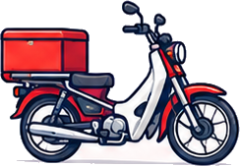
## The Workhorses of Urban Transit\n\nCommercial motorcycles are engineered to fulfill the demanding needs of urban logistics, last-mile parcel delivery, and service fleets. Unlike motorcycles crafted for recreational touring or sport performance, these two-wheelers are professional utility tools. As urban density increases and quick commerce expands, the commercial category provides a dependable, economical way to transport goods through gridlocked streets where larger vehicles struggle to operate.\n\n## Ergonomics and Practical Design\n\nFunctionality dictates every line of a commercial motorcycle. The bodywork is typically built from scratch-resistant, durable plastics that can tolerate daily impacts and harsh weather. Ergonomics prioritize long shifts in the saddle: an upright posture minimizes strain on the rider's lower back and wrists during repetitive stop-and-go movements. The rear section is engineered with integrated luggage racks, reinforced mounting plates, and flat surfaces ready to host heavy thermal delivery boxes, side panniers, or crate brackets.\n\n## Target Audience and Rider Profiles\n\nThis category is predominantly designed for:\n- **Delivery couriers:** Professionals who spend full workdays navigating dense city traffic.\n- **Small business owners:** Local restaurants, grocery services, and pharmacies needing rapid distribution channels.\n- **Fleet operators:** Companies that require reliable units with predictable maintenance cycles and accessible replacement parts.\n\nBecause many commercial models use automatic CVT transmissions or semi-automatic gearboxes, they are accessible to novice riders while remaining manageable for experienced couriers under fatigue.\n\n## Key Common Features\n\nAcross this category, commercial bikes share several practical traits:\n- **Small-to-Mid Displacement Engines:** Typically between 100 cc and 200 cc, calibrated specifically for thermal efficiency and fuel economy.\n- **Heavy-Duty Rear Suspension:** Reinforced dual shocks or heavy-load monoshocks that keep the vehicle stable when carrying cargo.\n- **Extended Luggage Infrastructure:** Factory-installed subframe brackets and rear racks designed for heavy load ratings.\n- **Durable Hardware:** Robust center stands, crash protection guards, and puncture-resistant tires for sustained pavement use.\n\n## Buying Guide: What to Look For\n\nWhen selecting a commercial motorcycle, payload capacity and rear frame rigidity are paramount. Verify that the bike accommodates your intended cargo size without destabilizing balance. Fuel tank size should be sufficient to prevent constant stops during busy delivery shifts. Finally, investigate local parts availability and basic service costs, as downtime translates directly into lost business revenue.\n\n## Who Is It Not For?\n\nCommercial motorcycles are not built for riders seeking spirited acceleration, aggressive cornering, or weekend leisure touring. With suspensions calibrated for loads, riding them unloaded can feel stiff and unrefined. High-speed highway travel and long-distance open-road touring are well outside their intended operating envelope.