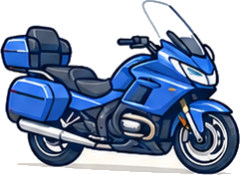
Touring Motorcycles
The touring category emerged as motorcyclists began pushing beyond regional borders, demanding machines capable of true continent-crossing range. Manufacturers responded by taking powerful engines and pairing them with protective fairings, substantial chassis platforms, and integrated storage. Today, touring motorcycles represent the peak of long-haul travel on two wheels, designed to cruise at highway speeds for hours without driver fatigue while carrying a full load of gear and a passenger.
Ergonomics and Riding Characteristics
Ergonomics define the touring experience. The rider triangle is engineered for a neutral, upright posture that eliminates strain on wrists, shoulders, and lower back. Floorboards or spacious footpegs allow for subtle foot adjustments during long stints, while deep, heavily cushioned saddles distribute body weight evenly. Expansive windscreens and aerodynamic fairings push rain, cold air, and wind turbulence away from both rider and passenger, drastically extending daily mileage capabilities.
Ideal Rider Profile and Experience Level
Touring motorcycles are built for riders who measure their trips in days and states rather than city blocks. They are the premier choice for couples touring together, offering unmatched passenger comfort with backrests and dedicated grab rails. Due to their physical size, broad dimensions, and wet weights often exceeding 350 kg, these motorcycles are best managed by intermediate to advanced riders who are confident in low-speed handling and balance.
Key Shared Characteristics of Touring Bikes
- Comprehensive Weather Protection: Large windscreens, wide fairings, and leg deflectors to shield from elements.
- Factory Hard Luggage: Side panniers and top cases engineered directly into the frame for balanced weight distribution.
- Comfort and Convenience Tech: Cruise control, heated grips and seats, integrated navigation, and high-fidelity audio systems.
- High-Displacement, High-Torque Engines: Low-revving, smooth engines designed for effortless cruising rather than abrupt acceleration.
What to Look for When Choosing a Touring Bike
Seat height and center of gravity are critical factors; you must be able to plant your feet firmly on the ground when stopping with a heavy payload. Inspect luggage capacity and latching mechanisms to ensure your gear fits securely. Additionally, test the wind management at highway speeds to verify that the windscreen does not create helmet buffeting for your specific height.
Who Is It Not For?
Touring motorcycles are not well-suited for daily urban commuting through heavy traffic, where their width and weight become cumbersome. Beginners will find the mass intimidating and unforgiving during parking lot maneuvers or emergency stops. Furthermore, riders seeking quick directional changes, aggressive cornering clearance, or off-road capability should look toward other segments.
Frequently Asked Questions
What is the touring category? ▾
The touring category consists of motorcycles specifically engineered for long-distance highway travel with an emphasis on comfort, weather protection, and luggage capacity. They feature large frames, relaxed ergonomics, and high-displacement engines designed for sustained cruising.
Who should choose a touring motorcycle? ▾
Riders planning multi-day trips, cross-country journeys, or frequent two-up riding with a passenger will benefit most from a touring bike. It suits those who prioritize travel endurance, luggage storage, and comfort over lightweight agility.
What are the main features of touring motorcycles? ▾
Key features include extensive fairings and adjustable windscreens for wind protection, integrated hard luggage cases, upright seating ergonomics, and electronic amenities such as cruise control, heated grips, and advanced infotainment.
Is it suitable for beginners, and what should riders watch out for? ▾
Touring bikes are generally not recommended for beginners due to their heavy curb weight and large dimensions. Maneuvering at parking lot speeds and holding the bike upright when coming to a stop require developed balance and throttle control.