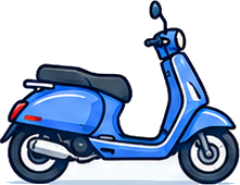
Scooter

Scooter Motorcycles

The modern scooter was created in mid-20th-century post-war Europe to provide an affordable, clean, and accessible personal transport solution. Unlike conventional motorcycles that exposed the rider to greasy chains and hot engine parts, scooters enclosed the mechanical components behind streamlined sheet metal and leg shields. Over the decades, the category expanded from basic micro-commuters into a diverse spectrum that includes high-capacity maxi-scooters capable of long-distance touring on highways.

Ergonomics and Riding Characteristics

The defining architectural element of a scooter is the step-through frame, allowing the rider to mount effortlessly without swinging a leg over a high fuel tank. The riding posture is upright and chair-like, with feet planted on protected floorboards rather than footpegs. This configuration shields the legs from road spray and wind while promoting neutral spinal alignment. Handlebar controls are simplified: the right lever actuates the front brake, the left lever controls the rear brake, and foot-operated pedals are completely eliminated.

Rider Profile and Target Audience

  • Urban Commuters: Riders navigating stop-and-go metropolitan traffic who prioritize ease of use and zero clutch fatigue.
  • Utility-Oriented Users: People who carry groceries, work bags, or gym gear daily and rely heavily on built-in under-seat compartments.
  • Novice Riders: Beginners wanting to master balance, lane positioning, and braking without the added cognitive load of gear selection.
  • All-Weather Riders: Commuters seeking maximum weather and road debris deflection for everyday travel in regular attire.

Common Characteristics of the Category

  • CVT Automatic Transmission: Continuously Variable Transmission that delivers smooth, linear acceleration directly via the throttle.
  • Integrated Storage: Generous under-seat storage capable of holding one or two helmets, complemented by glove boxes and cargo hooks.
  • Protective Bodywork: Wide front aprons and windscreens that shield the rider from wind, rain, and road dirt.
  • Low Center of Gravity: The engine and drivetrain are mounted low near the rear swingarm, making the vehicle easy to balance at low speeds.

What to Look for When Choosing a Scooter

Wheel size is a primary factor: smaller 10 to 12-inch wheels offer exceptional agility in tight alleys, whereas larger 14 to 16-inch wheels deliver greater stability over potholes and at higher speeds. Engine capacity should match the intended route; 50 to 125 cc engines excel in tight city centers, while 250 cc and larger maxi-scooters are required for ring roads and sustained highway cruising. Buyers should also verify that the under-seat space accommodates their specific helmet and confirm the inclusion of modern ABS braking.

Who Is It Not For?

Despite their unmatched practicality on paved roads, scooters are not suitable for every motorcycling objective. Riders seeking aggressive sport riding where the fuel tank is gripped between the knees for track cornering will find the chassis connection less engaging. Those planning off-road trail riding will be limited by low ground clearance, small wheels, and short suspension travel. Finally, purists who consider manual clutch manipulation and gear shifting essential to the riding experience will find the automatic transmission uninspiring.

Scooter Motorcycle Models

4,392 Scooter motorcycles listed

A1 LML Scooter 2012
  • Engine
    Single cylinder four-stroke
  • Power
    7.8 hp (5.8 kW)
  • Displacement
    125 cc
  • Bore/Stroke
    52.4mm / 57.8mm
A1 LML Scooter 2012
  • Engine
    Single cylinder four-stroke
  • Power
    7.8 hp (5.8 kW)
  • Displacement
    125 cc
  • Bore/Stroke
    52.4mm / 57.8mm
A1 LML Scooter 2012
  • Engine
    Single cylinder four-stroke
  • Power
    7.8 hp (5.7 kW)
  • Displacement
    125 cc
  • Bore/Stroke
    52.4mm / 57.8mm
A1 LML Scooter 2012
  • Engine
    Single cylinder four-stroke
  • Power
    7.8 hp (5.8 kW)
  • Displacement
    125 cc
  • Bore/Stroke
    52.4mm / 57.8mm
Lintex Scooter 2012
  • Engine
    Single cylinder four-stroke
  • Power
  • Displacement
    125 cc
  • Bore/Stroke
AM Linhai Scooter 2012
  • Engine
    Single cylinder four-stroke
  • Power
    3.4 hp (2.5 kW)
  • Displacement
    50 cc
  • Bore/Stroke
    39.0mm / 39.0mm
A2 Linhai Scooter 2012
  • Engine
    Single cylinder four-stroke
  • Power
    22.8 hp (16.8 kW)
  • Displacement
    352 cc
  • Bore/Stroke
    80.0mm / 70.0mm
A2 Linhai Scooter 2012
  • Engine
    Single cylinder four-stroke
  • Power
    21.5 hp (15.8 kW)
  • Displacement
    275 cc
  • Bore/Stroke
    72.5mm / 66.8mm
A2 Linhai Scooter 2012
  • Engine
    Single cylinder four-stroke
  • Power
    18.8 hp (13.8 kW)
  • Displacement
    275 cc
  • Bore/Stroke
    72.5mm / 66.8mm
A2 Linhai Scooter 2012
  • Engine
    Single cylinder four-stroke
  • Power
    8.1 hp (6.0 kW)
  • Displacement
    177 cc
  • Bore/Stroke
    62.5mm / 62.5mm
A1 Linhai Scooter 2012
  • Engine
    Single cylinder four-stroke
  • Power
    8.1 hp (5.9 kW)
  • Displacement
    125 cc
  • Bore/Stroke
    52.4mm / 57.8mm
Kymco Scooter 2012
  • Engine
    Single cylinder four-stroke
  • Power
  • Displacement
    175 cc
  • Bore/Stroke
    62.0mm / 57.8mm
Kymco Scooter 2012
  • Engine
    Single cylinder four-stroke
  • Power
  • Displacement
    499 cc
  • Bore/Stroke
    92.0mm / 75.0mm
2012 Kymco Xciting 400 Motorcycle A2 Kymco Scooter 2012
  • Engine
    Single cylinder four-stroke
  • Power
    34.8 hp (25.6 kW)
  • Displacement
    398 cc
  • Bore/Stroke
AM Kymco Scooter 2012
  • Engine
    Single cylinder four-stroke
  • Power
    3.4 hp (2.5 kW)
  • Displacement
    49 cc
  • Bore/Stroke
AM Kymco Scooter 2012
  • Engine
    Single cylinder two-stroke
  • Power
    1.5 hp (1.1 kW)
  • Displacement
    49 cc
  • Bore/Stroke
    39.0mm / 41.4mm
2012 Kymco Sento 50 Motorcycle AM Kymco Scooter 2012
  • Engine
    Single cylinder four-stroke
  • Power
    4.0 hp (2.9 kW)
  • Displacement
    50 cc
  • Bore/Stroke
    39.0mm / 41.1mm
AM Kymco Scooter 2012
  • Engine
    Single cylinder four-stroke
  • Power
    3.5 hp (2.6 kW)
  • Displacement
    49 cc
  • Bore/Stroke
    39.0mm / 41.0mm
A1 Kymco Scooter 2012
  • Engine
    Single cylinder four-stroke
  • Power
    9.3 hp (6.8 kW)
  • Displacement
    124 cc
  • Bore/Stroke
    54.0mm / 54.0mm
2012 Kymco People 50 Motorcycle AM Kymco Scooter 2012
  • Engine
    Single cylinder two-stroke
  • Power
  • Displacement
    49 cc
  • Bore/Stroke
    39.0mm / 41.4mm
Kymco Scooter 2012
  • Engine
    Single cylinder four-stroke
  • Power
  • Displacement
    152 cc
  • Bore/Stroke
    57.4mm / 57.8mm
A Kymco Scooter 2012
  • Engine
    Twin four-stroke
  • Power
    59.0 hp (43.4 kW)
  • Displacement
    700 cc
  • Bore/Stroke
    76.9mm / 75.3mm
AM Kymco Scooter 2012
  • Engine
    Single cylinder two-stroke
  • Power
    1.5 hp (1.1 kW)
  • Displacement
    49 cc
  • Bore/Stroke
    39.0mm / 41.4mm
AM Kymco Scooter 2012
  • Engine
    Single cylinder two-stroke
  • Power
    1.5 hp (1.1 kW)
  • Displacement
    49 cc
  • Bore/Stroke
    39.0mm / 41.4mm
A1 Kymco Scooter 2012
  • Engine
    Single cylinder four-stroke
  • Power
    15.0 hp (11.0 kW)
  • Displacement
    125 cc
  • Bore/Stroke
    54.0mm / 54.8mm
A2 Kymco Scooter 2012
  • Engine
    Single cylinder four-stroke
  • Power
    17.4 hp (12.8 kW)
  • Displacement
    271 cc
  • Bore/Stroke
    72.7mm / 65.2mm
A1 Kymco Scooter 2012
  • Engine
    Single cylinder four-stroke
  • Power
    11.5 hp (8.5 kW)
  • Displacement
    125 cc
  • Bore/Stroke
    52.4mm / 57.8mm
AM Kymco Scooter 2012
  • Engine
    Single cylinder four-stroke
  • Power
    3.8 hp (2.8 kW)
  • Displacement
    50 cc
  • Bore/Stroke
    39.0mm / 41.4mm
2012 Kymco City 50 Motorcycle AM Kymco Scooter 2012
  • Engine
    Single cylinder four-stroke
  • Power
    3.5 hp (2.6 kW)
  • Displacement
    50 cc
  • Bore/Stroke
    39.0mm / 41.1mm
A1 Kymco Scooter 2012
  • Engine
    Single cylinder four-stroke
  • Power
    9.4 hp (6.9 kW)
  • Displacement
    125 cc
  • Bore/Stroke
## What is a Scooter and How Did It Originate? The modern scooter was created in mid-20th-century post-war Europe to provide an affordable, clean, and accessible personal transport solution. Unlike conventional motorcycles that exposed the rider to greasy chains and hot engine parts, scooters enclosed the mechanical components behind streamlined sheet metal and leg shields. Over the decades, the category expanded from basic micro-commuters into a diverse spectrum that includes high-capacity maxi-scooters capable of long-distance touring on highways. ## Ergonomics and Riding Characteristics The defining architectural element of a scooter is the step-through frame, allowing the rider to mount effortlessly without swinging a leg over a high fuel tank. The riding posture is upright and chair-like, with feet planted on protected floorboards rather than footpegs. This configuration shields the legs from road spray and wind while promoting neutral spinal alignment. Handlebar controls are simplified: the right lever actuates the front brake, the left lever controls the rear brake, and foot-operated pedals are completely eliminated. ## Rider Profile and Target Audience - **Urban Commuters:** Riders navigating stop-and-go metropolitan traffic who prioritize ease of use and zero clutch fatigue. - **Utility-Oriented Users:** People who carry groceries, work bags, or gym gear daily and rely heavily on built-in under-seat compartments. - **Novice Riders:** Beginners wanting to master balance, lane positioning, and braking without the added cognitive load of gear selection. - **All-Weather Riders:** Commuters seeking maximum weather and road debris deflection for everyday travel in regular attire. ## Common Characteristics of the Category - **CVT Automatic Transmission:** Continuously Variable Transmission that delivers smooth, linear acceleration directly via the throttle. - **Integrated Storage:** Generous under-seat storage capable of holding one or two helmets, complemented by glove boxes and cargo hooks. - **Protective Bodywork:** Wide front aprons and windscreens that shield the rider from wind, rain, and road dirt. - **Low Center of Gravity:** The engine and drivetrain are mounted low near the rear swingarm, making the vehicle easy to balance at low speeds. ## What to Look for When Choosing a Scooter Wheel size is a primary factor: smaller 10 to 12-inch wheels offer exceptional agility in tight alleys, whereas larger 14 to 16-inch wheels deliver greater stability over potholes and at higher speeds. Engine capacity should match the intended route; 50 to 125 cc engines excel in tight city centers, while 250 cc and larger maxi-scooters are required for ring roads and sustained highway cruising. Buyers should also verify that the under-seat space accommodates their specific helmet and confirm the inclusion of modern ABS braking. ## Who Is It Not For? Despite their unmatched practicality on paved roads, scooters are not suitable for every motorcycling objective. Riders seeking aggressive sport riding where the fuel tank is gripped between the knees for track cornering will find the chassis connection less engaging. Those planning off-road trail riding will be limited by low ground clearance, small wheels, and short suspension travel. Finally, purists who consider manual clutch manipulation and gear shifting essential to the riding experience will find the automatic transmission uninspiring.

Frequently Asked Questions

What is the Scooter category?

The scooter category consists of two-wheelers featuring an automatic twist-and-go transmission, a step-through frame, and integrated under-seat storage. They are engineered primarily for effortless and practical urban transportation.

Who should choose a Scooter?

Scooters are suited for city commuters avoiding traffic stress, riders needing built-in luggage space, and anyone seeking straightforward personal transport. They also appeal to riders who want solid wind and road spray protection.

What are the main characteristics of scooters?

Key traits include a Continuously Variable Transmission (CVT), helmet-sized under-seat storage, weather-protective front fairings, and an upright riding posture. Their low center of gravity makes them exceptionally easy to handle at low speeds.

Are scooters suitable for beginners and what should they watch out for?

They are ideal for beginners because they eliminate the complexity of manual gear changes and clutch control. However, smaller wheels can be sensitive to road imperfections, so new riders should look for models equipped with ABS and stable chassis setups.