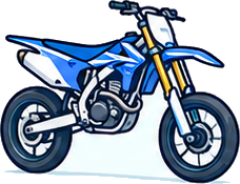
Cross / motocross Motorcycles
Motocross originated from early 20th-century off-road scramble events in the United Kingdom, gradually evolving into a dedicated competitive sport held on enclosed dirt circuits. Unlike standard motorcycles built for public roads, motocross bikes are strictly engineered to navigate rough surfaces, steep elevation changes, deep ruts, and massive jumps. Over decades of competition-driven development, these machines have been stripped of every non-essential component to maximize power-to-weight ratio and structural resilience over harsh terrain.
Design, Ergonomics, and Riding Stance
A motocross bike is easily identified by its tall seat height, slim chassis, and flat profile. This continuous bench-like seat allows the rider to slide forward for cornering traction and backward during heavy braking or steep descents. The riding stance is upright with a wide handlebar for maximum leverage. Because most high-intensity riding occurs while standing on the footpegs, the bike is designed around lower-body grip and active weight transfer. Street elements like turn signals, headlights, instrument clusters, and side stands are intentionally absent.
Major Common Characteristics
Motocross machines share several distinct mechanical and structural attributes:
- Minimal Weight: Weighing typically between 95 and 110 kg, their lightness allows for effortless mid-air correction and sharp directional changes.
- Long-Travel Suspension: Front and rear suspension travel of roughly 300 mm absorbs the harsh impacts of big landings and braking bumps.
- Aggressive Knobby Tires: Typically running a 21-inch front and a 19-inch rear wheel, the open-tread pattern bites into loose dirt, sand, and mud.
- Direct Power Delivery: Both two-stroke and four-stroke variants are tuned for instantaneous throttle response and strong mid-to-top-end power.
Who Rides Motocross Motorcycles?
This category appeals directly to riders seeking intense physical activity and high-level machine control in controlled off-road environments. It suits amateur competitors spending weekends at private motocross tracks, off-road enthusiasts wanting to sharpen their balance and throttle finesse, and dedicated racing athletes. It demands good physical conditioning, as handling these machines on demanding terrain is a full-body workout.
Key Considerations When Choosing a Bike
Selecting a motocross machine requires matching engine displacement and powerband characteristics to the rider's physical build and skill level. Two-stroke engines offer lighter weight and an abrupt power surge, whereas modern four-stroke units provide broader, more manageable torque. When evaluating used models, inspecting hour meters, suspension linkages, swingarm bearings, frame integrity, and air filter maintenance is crucial, as service intervals in this category are measured strictly in engine running hours rather than mileage.
Who Should Avoid This Category?
Motocross bikes are not suitable for commuters, adventure tourers, or casual road riders. Lacking lights, mirrors, an ignition key, and official road registration, they cannot legally be ridden on public streets. Furthermore, their rigid seats, small fuel tanks, and strict maintenance schedules—such as frequent piston and oil changes—make them impractical for anyone looking for low-maintenance, general-purpose transportation.
Frequently Asked Questions
What is the Cross / Motocross category? ▾
Motocross bikes are specialized, non-street-legal off-road machines designed specifically for racing and riding on closed dirt tracks featuring jumps, ruts, and berms.
Who should choose a Cross / Motocross motorcycle? ▾
Riders focused on closed-course dirt track riding, technical off-road skills, and physically demanding motorsport training will benefit most from this category.
What are the main features of Motocross motorcycles? ▾
Key traits include ultra-lightweight frames around 100 kg, long-travel suspension of roughly 300 mm, deep-tread knobby tires, and the total absence of street equipment like lights and mirrors.
Is it suitable for beginners, and what should they consider? ▾
They can be demanding for total beginners due to tall seat heights and abrupt power delivery; newcomers should start with smaller displacement engines and invest in full protective gear.