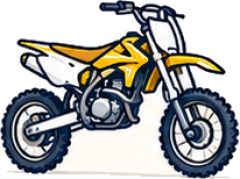
Minibike, cross

Minibike, cross Motorcycles

Minibike cross machines are purpose-built, scaled-down adaptations of full-sized motocross and enduro motorcycles. Originally engineered to give younger riders a safe, manageable path into off-road riding, the category has evolved into a global phenomenon. Today, these compact dirt bikes are not only used as learning tools for children and teenagers, but also as dedicated practice and play bikes for adults who want to sharpen their riding technique in confined off-road environments.

Design, Ergonomics, and Riding Posture

The architecture of a cross minibike prioritizes simplicity, low mass, and rider control:

  • Accessible Seat Height: While full-size dirt bikes often feature seat heights exceeding 900 mm, minibikes typically range between 600 mm and 800 mm. This allows riders to easily plant both feet on the ground, minimizing tip-overs and building confidence.
  • Riding Triangle: The relationship between the seat, footpegs, and handlebar promotes an upright, active posture suitable for both seated control and standing on the pegs through ruts and bumps.
  • Minimalist Construction: The bodywork is stripped down to durable, flexible plastic fairings that can withstand frequent drops without cracking. The frames are made from compact steel or aluminum tubing built to absorb ground impacts.

Target Rider Profile and Experience Level

This category caters directly to beginners taking their first steps on loose terrain, as the low weight and predictable power delivery remove the intimidation factor of standard dirt bikes. Additionally, intermediate and advanced riders frequently use cross minibikes for close-quarters track practice, working on body positioning, braking control, and drifting the rear tire at lower, safer speeds. It serves anyone looking to build fundamental motorcycle skills away from public traffic.

Major Shared Characteristics of the Category

  • Displacement and Engine Types: Engines typically span from 50cc to 150cc, comprising durable, air-cooled 4-stroke units or lively 2-stroke options. The powerband is tuned to be progressive and controllable.
  • Ultralight Curb Weight: Tipping the scales between 40 kg and 85 kg, these bikes are easy to pick up after a slide and can be transported in the back of an SUV or pickup truck without heavy ramps.
  • Knobby Wheel Combinations: Utilizing smaller wheel sizes (commonly 10 to 14 inches) wrapped in aggressive knobby tires, they provide traction across dirt, mud, and gravel.
  • Progressive Transmission Systems: Options range from fully automatic and centrifugal semi-automatic gearboxes to standard manual clutches, allowing riders to advance at their own pace.

What to Consider When Choosing a Model

When evaluating a cross minibike, matching seat height to the rider's inseam is crucial. If an adult intends to ride, verifying frame weight ratings and the availability of heavier suspension springs is essential to avoid bottoming out. Routine maintenance accessibility—such as easy air filter servicing, chain adjustment, and oil drain placement—should also influence the decision, ensuring the bike remains reliable over time.

Who Should Look for Another Category?

Cross minibikes are strictly off-road vehicles and are generally not road-legal, lacking mirrors, indicators, and registration approval for public streets. They are not built for open highway speeds, long-distance touring, or navigating severe, boulder-strewn alpine terrain where large wheel diameters and deep suspension travel are required. Riders seeking high-speed stability or competitive high-jump capability should look toward full-size motocross machinery instead.

Minibike, cross Motorcycle Models

331 Minibike, cross motorcycles listed

Minibike, cross 2016
  • Engine
    Single cylinder two-stroke
  • Power
  • Displacement
    50 cc
  • Bore/Stroke
Minibike, cross 2016
  • Engine
    Single cylinder four-stroke
  • Power
    8.1 hp (5.9 kW)
  • Displacement
    107 cc
  • Bore/Stroke
    52.3mm / 49.5mm
Minibike, cross 2015
  • Engine
    Single cylinder two-stroke
  • Power
    3.6 hp (2.6 kW)
  • Displacement
    72 cc
  • Bore/Stroke
    47.0mm / 41.4mm
Minibike, cross 2015
  • Engine
    Single cylinder two-stroke
  • Power
    2.0 hp (1.5 kW)
  • Displacement
    50 cc
  • Bore/Stroke
    39.0mm / 41.1mm
Minibike, cross 2015
  • Engine
    Single cylinder four-stroke
  • Power
    6.5 hp (4.8 kW)
  • Displacement
    124 cc
  • Bore/Stroke
    52.4mm / 57.0mm
Minibike, cross 2015
  • Engine
    Single cylinder four-stroke
  • Power
    6.5 hp (4.8 kW)
  • Displacement
    124 cc
  • Bore/Stroke
    52.4mm / 57.0mm
Minibike, cross 2015
  • Engine
    Single cylinder four-stroke
  • Power
    6.5 hp (4.8 kW)
  • Displacement
    124 cc
  • Bore/Stroke
    52.4mm / 57.0mm
Skyteam Minibike, cross 2014
  • Engine
    Single cylinder four-stroke
  • Power
    6.7 hp (4.9 kW)
  • Displacement
    124 cc
  • Bore/Stroke
Pitster Pro Minibike, cross 2013
  • Engine
    Single cylinder four-stroke
  • Power
  • Displacement
    49 cc
  • Bore/Stroke
    39.5mm / 41.5mm
Pitster Pro Minibike, cross 2013
  • Engine
    Single cylinder four-stroke
  • Power
  • Displacement
    88 cc
  • Bore/Stroke
    47.0mm / 49.5mm
Pitster Pro Minibike, cross 2013
  • Engine
    Single cylinder four-stroke
  • Power
  • Displacement
    140 cc
  • Bore/Stroke
    56.0mm / 57.0mm
Pitster Pro Minibike, cross 2013
  • Engine
    Single cylinder four-stroke
  • Power
  • Displacement
    140 cc
  • Bore/Stroke
    56.0mm / 57.0mm
Pitster Pro Minibike, cross 2013
  • Engine
    Single cylinder four-stroke
  • Power
  • Displacement
    140 cc
  • Bore/Stroke
    56.0mm / 57.0mm
Pitster Pro Minibike, cross 2013
  • Engine
    Single cylinder four-stroke
  • Power
  • Displacement
    120 cc
  • Bore/Stroke
    56.0mm / 57.0mm
Pitster Pro Minibike, cross 2013
  • Engine
    Single cylinder four-stroke
  • Power
  • Displacement
    155 cc
  • Bore/Stroke
    60.0mm / 55.0mm
Mikilon Minibike, cross 2013
  • Engine
    Single cylinder four-stroke
  • Power
    7.4 hp (5.4 kW)
  • Displacement
    70 cc
  • Bore/Stroke
Husqvarna Minibike, cross 2013
  • Engine
    Single cylinder two-stroke
  • Power
  • Displacement
    65 cc
  • Bore/Stroke
    45.0mm / 40.8mm
Husqvarna Minibike, cross 2013
  • Engine
    Single cylinder two-stroke
  • Power
  • Displacement
    49 cc
  • Bore/Stroke
    39.5mm / 40.0mm
Cobra Minibike, cross 2013
  • Engine
    Single cylinder two-stroke
  • Power
  • Displacement
    50 cc
  • Bore/Stroke
    39.0mm / 41.7mm
Cobra Minibike, cross 2013
  • Engine
    Single cylinder two-stroke
  • Power
  • Displacement
    50 cc
  • Bore/Stroke
    39.0mm / 41.7mm
Xingyue Minibike, cross 2012
  • Engine
    Single cylinder four-stroke
  • Power
    6.8 hp (5.0 kW)
  • Displacement
    107 cc
  • Bore/Stroke
    52.4mm / 59.0mm
Quantya Minibike, cross 2012
  • Engine
    Electric Electric
  • Power
    7.4 hp (5.4 kW)
  • Displacement
  • Bore/Stroke
Pitster Pro Minibike, cross 2012
  • Engine
    Single cylinder four-stroke
  • Power
  • Displacement
    110 cc
  • Bore/Stroke
    52.5mm / 49.5mm
Cobra Minibike, cross 2012
  • Engine
    Single cylinder two-stroke
  • Power
  • Displacement
    50 cc
  • Bore/Stroke
    39.0mm / 41.7mm
Aeon Minibike, cross 2012
  • Engine
    Single cylinder two-stroke
  • Power
    9.4 hp (6.9 kW)
  • Displacement
    49 cc
  • Bore/Stroke
Aeon Minibike, cross 2012
  • Engine
    Single cylinder two-stroke
  • Power
    3.4 hp (2.5 kW)
  • Displacement
    49 cc
  • Bore/Stroke
    40.0mm / 39.3mm
Tauris Minibike, cross 2011
  • Engine
    Single cylinder four-stroke
  • Power
    11.5 hp (8.5 kW)
  • Displacement
    124 cc
  • Bore/Stroke
Quantya Minibike, cross 2011
  • Engine
    Electric Electric
  • Power
    7.4 hp (5.4 kW)
  • Displacement
  • Bore/Stroke
Lifan Minibike, cross 2011
  • Engine
    Single cylinder four-stroke
  • Power
  • Displacement
    50 cc
  • Bore/Stroke
    49.5mm / 39.0mm
Lem Minibike, cross 2011
  • Engine
    Single cylinder two-stroke
  • Power
    12.8 hp (9.4 kW)
  • Displacement
    50 cc
  • Bore/Stroke
    39.1mm / 41.7mm
## What is a Cross Minibike and How Did It Originate? Minibike cross machines are purpose-built, scaled-down adaptations of full-sized motocross and enduro motorcycles. Originally engineered to give younger riders a safe, manageable path into off-road riding, the category has evolved into a global phenomenon. Today, these compact dirt bikes are not only used as learning tools for children and teenagers, but also as dedicated practice and play bikes for adults who want to sharpen their riding technique in confined off-road environments. ## Design, Ergonomics, and Riding Posture The architecture of a cross minibike prioritizes simplicity, low mass, and rider control: - **Accessible Seat Height:** While full-size dirt bikes often feature seat heights exceeding 900 mm, minibikes typically range between 600 mm and 800 mm. This allows riders to easily plant both feet on the ground, minimizing tip-overs and building confidence. - **Riding Triangle:** The relationship between the seat, footpegs, and handlebar promotes an upright, active posture suitable for both seated control and standing on the pegs through ruts and bumps. - **Minimalist Construction:** The bodywork is stripped down to durable, flexible plastic fairings that can withstand frequent drops without cracking. The frames are made from compact steel or aluminum tubing built to absorb ground impacts. ## Target Rider Profile and Experience Level This category caters directly to beginners taking their first steps on loose terrain, as the low weight and predictable power delivery remove the intimidation factor of standard dirt bikes. Additionally, intermediate and advanced riders frequently use cross minibikes for close-quarters track practice, working on body positioning, braking control, and drifting the rear tire at lower, safer speeds. It serves anyone looking to build fundamental motorcycle skills away from public traffic. ## Major Shared Characteristics of the Category - **Displacement and Engine Types:** Engines typically span from 50cc to 150cc, comprising durable, air-cooled 4-stroke units or lively 2-stroke options. The powerband is tuned to be progressive and controllable. - **Ultralight Curb Weight:** Tipping the scales between 40 kg and 85 kg, these bikes are easy to pick up after a slide and can be transported in the back of an SUV or pickup truck without heavy ramps. - **Knobby Wheel Combinations:** Utilizing smaller wheel sizes (commonly 10 to 14 inches) wrapped in aggressive knobby tires, they provide traction across dirt, mud, and gravel. - **Progressive Transmission Systems:** Options range from fully automatic and centrifugal semi-automatic gearboxes to standard manual clutches, allowing riders to advance at their own pace. ## What to Consider When Choosing a Model When evaluating a cross minibike, matching seat height to the rider's inseam is crucial. If an adult intends to ride, verifying frame weight ratings and the availability of heavier suspension springs is essential to avoid bottoming out. Routine maintenance accessibility—such as easy air filter servicing, chain adjustment, and oil drain placement—should also influence the decision, ensuring the bike remains reliable over time. ## Who Should Look for Another Category? Cross minibikes are strictly off-road vehicles and are generally not road-legal, lacking mirrors, indicators, and registration approval for public streets. They are not built for open highway speeds, long-distance touring, or navigating severe, boulder-strewn alpine terrain where large wheel diameters and deep suspension travel are required. Riders seeking high-speed stability or competitive high-jump capability should look toward full-size motocross machinery instead.

Frequently Asked Questions

What is the Minibike Cross category?

Minibike Cross refers to scaled-down off-road motorcycles featuring compact frames, low seat heights, and small-displacement engines. They are engineered for controlled riding on dirt tracks, private land, and tight trails.

Who should choose a Minibike Cross?

They are ideal for youth and beginners learning off-road fundamentals, as well as adult riders looking for a low-consequence practice bike to refine balance and throttle control. Anyone wanting lightweight fun on loose ground will benefit.

What are the key characteristics of cross minibikes?

Key traits include light curb weights (40 to 85 kg), manageable seat heights (600 to 800 mm), and small knobby wheels. They feature simple, durable engines with predictable power delivery and straightforward maintenance.

Are they suitable for beginners and what should riders keep in mind?

They are exceptionally well suited for beginners due to their low center of gravity and forgiving handling. Riders must note that they are not road-legal and should only be operated on private property or designated tracks with proper safety gear.