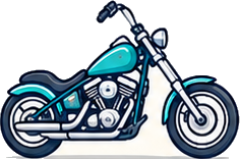
Chopper / Cruiser

Chopper / Cruiser Motorcycles

The cruiser concept originated in mid-20th-century America, designed to travel long distances on broad highway networks in comfort. Choppers emerged shortly after World War II when riders removed excess bodywork ("chopped" off parts) to reduce weight and modified frame neck angles and front forks for a distinct, stripped-down look. Today, cruisers represent factory-produced, torque-rich touring machines, while choppers retain a more custom, minimalist silhouette with extended front ends. In this catalog, both styles are brought together due to their shared geometry, ergonomic characteristics, and relaxed road presence.

Design and Riding Ergonomics

The defining trait of a cruiser or chopper is its seating position. Seats are exceptionally low, commonly resting between 650 mm and 720 mm from the pavement. Foot controls are typically placed forward or mid-mount, allowing the legs to stretch out rather than tuck under the torso. The handlebar sweeps back toward the rider, supporting an upright or slightly reclined posture. This setup relieves strain on wrists and knees during steady highway travel. However, without a fairing or windshield, the rider's chest catches oncoming airflow directly, which can cause fatigue at sustained high speeds.

Rider Profile: Who Is It For?

This category appeals to specific riding needs and preferences:

  • Riders Seeking Low Seat Height: Excellent for those who want both feet flat on the ground at stops, boosting confidence during low-speed maneuvers.
  • Relaxed Distance Tourers: Ideal for individuals who enjoy scenic routes and steady speeds rather than rapid acceleration and sharp lean angles.
  • Customization Enthusiasts: A widely supported platform for bolt-on accessories, luggage systems, custom exhausts, and bespoke seats.
  • Casual Commuters: Riders who want an unhurried, mechanically grounded commute without the high-rev urgency of sport engines.

Key Technical Characteristics

  • Low-RPM Torque Engines: Commonly powered by large-displacement V-twins or parallel-twins, tuned to deliver pulling power from idle without demanding frequent gear shifts.
  • Belt or Shaft Final Drive: Many models utilize quiet, low-maintenance belt drives or shaft systems instead of exposed chains.
  • Long Wheelbase and Low Center of Gravity: Delivers exceptional straight-line tracking and makes the bike feel lighter once rolling than its static weight suggests.
  • Substantial Kerb Weight: Heavy steel frames and metallic components contribute to a planted road feel, though requiring deliberate effort when maneuvering manually.

What to Look for When Choosing

Pay close attention to wet weight and foot control positioning. A motorcycle weighing between 240 kg and 380 kg requires proper footing and spatial awareness in parking areas. Ensure the distance to the footpegs does not overextend your knees or lower back. Check the rear suspension travel; due to the lowered rear end, some models offer limited stroke, which can feel harsh on broken pavement. Dual-disc front brakes and modern electronic aids like ABS are significant safety assets on heavier models.

Who Is This Category Not For?

  • Sport and Track Enthusiasts: Low ground clearance causes footpegs and exhaust pipes to scrape early in corners, limiting aggressive cornering.
  • Adventure and Rough-Road Riders: Short suspension travel and firm setups transmit pothole impacts directly to the rider's spine.
  • Dense Urban Filtering: Wide bars and a long turning radius make slicing through tight metropolitan traffic and tight U-turns more demanding than on standard or naked bikes.

Chopper / Cruiser Motorcycle Models

1,706 Chopper / Cruiser motorcycles listed

A2 Yamaha Chopper / Cruiser 2011
  • Engine
    V2 four-stroke
  • Power
    32.2 hp (23.7 kW)
  • Displacement
    399 cc
  • Bore/Stroke
    68.0mm / 55.0mm
A Yamaha Chopper / Cruiser 2011
  • Engine
    V2 four-stroke
  • Power
    60.4 hp (44.4 kW)
  • Displacement
    1,063 cc
  • Bore/Stroke
    95.0mm / 75.0mm
A2 Yamaha Chopper / Cruiser 2011
  • Engine
    V2 four-stroke
  • Power
    32.2 hp (23.7 kW)
  • Displacement
    399 cc
  • Bore/Stroke
    68.0mm / 55.0mm
A2 Yamaha Chopper / Cruiser 2011
  • Engine
    V2 four-stroke
  • Power
    20.8 hp (15.3 kW)
  • Displacement
    249 cc
  • Bore/Stroke
    49.0mm / 66.0mm
A Yamaha Chopper / Cruiser 2011
  • Engine
    V2 four-stroke
  • Power
    60.4 hp (44.4 kW)
  • Displacement
    1,063 cc
  • Bore/Stroke
    95.0mm / 75.0mm
A2 Xingyue Chopper / Cruiser 2011
  • Engine
    Single cylinder four-stroke
  • Power
    26.8 hp (19.7 kW)
  • Displacement
    387 cc
  • Bore/Stroke
    91.0mm / 59.5mm
Xingyue Chopper / Cruiser 2011
  • Engine
    Single cylinder four-stroke
  • Power
  • Displacement
    149 cc
  • Bore/Stroke
    62.0mm / 49.5mm
Victory Chopper / Cruiser 2011
  • Engine
    V2 four-stroke
  • Power
  • Displacement
    1,731 cc
  • Bore/Stroke
    101.0mm / 108.0mm
Victory Chopper / Cruiser 2011
  • Engine
    V2 four-stroke
  • Power
  • Displacement
    1,731 cc
  • Bore/Stroke
    101.0mm / 108.0mm
2011 Victory Hammer Motorcycle A Victory Chopper / Cruiser 2011
  • Engine
    V2 four-stroke
  • Power
    97.0 hp (71.3 kW)
  • Displacement
    1,731 cc
  • Bore/Stroke
    101.0mm / 108.0mm
Ultra Chopper / Cruiser 2011
  • Engine
    V2 four-stroke
  • Power
  • Displacement
    1,852 cc
  • Bore/Stroke
Ultra Chopper / Cruiser 2011
  • Engine
    V2 four-stroke
  • Power
  • Displacement
    1,852 cc
  • Bore/Stroke
Ultra Chopper / Cruiser 2011
  • Engine
    V2 four-stroke
  • Power
  • Displacement
    1,852 cc
  • Bore/Stroke
A Titan Chopper / Cruiser 2011
  • Engine
    V2 four-stroke
  • Power
    112.0 hp (82.4 kW)
  • Displacement
    1,750 cc
  • Bore/Stroke
    101.6mm / 113.0mm
2011 Suzuki VZR 1800 Motorcycle Suzuki Chopper / Cruiser 2011
  • Engine
    V2 four-stroke
  • Power
  • Displacement
    1,783 cc
  • Bore/Stroke
    112.0mm / 90.5mm
A2 Suzuki Chopper / Cruiser 2011
  • Engine
    V2 four-stroke
  • Power
    32.2 hp (23.7 kW)
  • Displacement
    399 cc
  • Bore/Stroke
    65.0mm / 60.2mm
2011 Suzuki GZ 125 Motorcycle A1 Suzuki Chopper / Cruiser 2011
  • Engine
    Single cylinder four-stroke
  • Power
    12.0 hp (8.8 kW)
  • Displacement
    125 cc
  • Bore/Stroke
    57.0mm / 48.8mm
Suzuki Chopper / Cruiser 2011
  • Engine
    V2 four-stroke
  • Power
  • Displacement
    1,360 cc
  • Bore/Stroke
    94.0mm / 98.0mm
Suzuki Chopper / Cruiser 2011
  • Engine
    V2 four-stroke
  • Power
  • Displacement
    805 cc
  • Bore/Stroke
    83.0mm / 74.4mm
Suzuki Chopper / Cruiser 2011
  • Engine
    V2 four-stroke
  • Power
  • Displacement
    805 cc
  • Bore/Stroke
    83.0mm / 74.4mm
Suzuki Chopper / Cruiser 2011
  • Engine
    V2 four-stroke
  • Power
  • Displacement
    1,783 cc
  • Bore/Stroke
    112.0mm / 90.5mm
Senke Chopper / Cruiser 2011
  • Engine
    Single cylinder two-stroke
  • Power
  • Displacement
    149 cc
  • Bore/Stroke
Chopper / Cruiser 2011
  • Engine
    V2 four-stroke
  • Power
  • Displacement
    1,524 cc
  • Bore/Stroke
    92.2mm / 114.3mm
Chopper / Cruiser 2011
  • Engine
    V2 four-stroke
  • Power
  • Displacement
    1,337 cc
  • Bore/Stroke
    101.6mm / 114.3mm
Road Hopper Chopper / Cruiser 2011
  • Engine
    V2 four-stroke
  • Power
  • Displacement
    1,337 cc
  • Bore/Stroke
    88.0mm / 108.0mm
A2 Rhino Chopper / Cruiser 2011
  • Engine
    V2 four-stroke
  • Power
    17.0 hp (12.5 kW)
  • Displacement
    250 cc
  • Bore/Stroke
A2 Chopper / Cruiser 2011
  • Engine
    Single cylinder four-stroke
  • Power
    18.0 hp (13.2 kW)
  • Displacement
    244 cc
  • Bore/Stroke
    72.0mm / 60.0mm
A2 Moto Guzzi Chopper / Cruiser 2011
  • Engine
    V2 four-stroke
  • Power
    47.6 hp (35.0 kW)
  • Displacement
    744 cc
  • Bore/Stroke
    80.0mm / 74.0mm
A2 Moto Guzzi Chopper / Cruiser 2011
  • Engine
    V2 four-stroke
  • Power
    47.6 hp (35.0 kW)
  • Displacement
    744 cc
  • Bore/Stroke
A Moto Guzzi Chopper / Cruiser 2011
  • Engine
    V2 four-stroke
  • Power
    73.8 hp (54.3 kW)
  • Displacement
    1,064 cc
  • Bore/Stroke
    92.0mm / 80.0mm
## Origins and Understanding the Category The cruiser concept originated in mid-20th-century America, designed to travel long distances on broad highway networks in comfort. Choppers emerged shortly after World War II when riders removed excess bodywork ("chopped" off parts) to reduce weight and modified frame neck angles and front forks for a distinct, stripped-down look. Today, cruisers represent factory-produced, torque-rich touring machines, while choppers retain a more custom, minimalist silhouette with extended front ends. In this catalog, both styles are brought together due to their shared geometry, ergonomic characteristics, and relaxed road presence. ## Design and Riding Ergonomics The defining trait of a cruiser or chopper is its seating position. Seats are exceptionally low, commonly resting between 650 mm and 720 mm from the pavement. Foot controls are typically placed forward or mid-mount, allowing the legs to stretch out rather than tuck under the torso. The handlebar sweeps back toward the rider, supporting an upright or slightly reclined posture. This setup relieves strain on wrists and knees during steady highway travel. However, without a fairing or windshield, the rider's chest catches oncoming airflow directly, which can cause fatigue at sustained high speeds. ## Rider Profile: Who Is It For? This category appeals to specific riding needs and preferences: - **Riders Seeking Low Seat Height:** Excellent for those who want both feet flat on the ground at stops, boosting confidence during low-speed maneuvers. - **Relaxed Distance Tourers:** Ideal for individuals who enjoy scenic routes and steady speeds rather than rapid acceleration and sharp lean angles. - **Customization Enthusiasts:** A widely supported platform for bolt-on accessories, luggage systems, custom exhausts, and bespoke seats. - **Casual Commuters:** Riders who want an unhurried, mechanically grounded commute without the high-rev urgency of sport engines. ## Key Technical Characteristics - **Low-RPM Torque Engines:** Commonly powered by large-displacement V-twins or parallel-twins, tuned to deliver pulling power from idle without demanding frequent gear shifts. - **Belt or Shaft Final Drive:** Many models utilize quiet, low-maintenance belt drives or shaft systems instead of exposed chains. - **Long Wheelbase and Low Center of Gravity:** Delivers exceptional straight-line tracking and makes the bike feel lighter once rolling than its static weight suggests. - **Substantial Kerb Weight:** Heavy steel frames and metallic components contribute to a planted road feel, though requiring deliberate effort when maneuvering manually. ## What to Look for When Choosing Pay close attention to wet weight and foot control positioning. A motorcycle weighing between 240 kg and 380 kg requires proper footing and spatial awareness in parking areas. Ensure the distance to the footpegs does not overextend your knees or lower back. Check the rear suspension travel; due to the lowered rear end, some models offer limited stroke, which can feel harsh on broken pavement. Dual-disc front brakes and modern electronic aids like ABS are significant safety assets on heavier models. ## Who Is This Category Not For? - **Sport and Track Enthusiasts:** Low ground clearance causes footpegs and exhaust pipes to scrape early in corners, limiting aggressive cornering. - **Adventure and Rough-Road Riders:** Short suspension travel and firm setups transmit pothole impacts directly to the rider's spine. - **Dense Urban Filtering:** Wide bars and a long turning radius make slicing through tight metropolitan traffic and tight U-turns more demanding than on standard or naked bikes.

Frequently Asked Questions

What is the Chopper / Cruiser category?

It is a motorcycle class defined by low seat heights, forward or mid-mount foot controls, and wide handlebars, engineered primarily for relaxed, comfortable highway cruising.

Who should choose a Chopper / Cruiser?

Riders who value steady pacing, an upright or relaxed seating posture, low-end engine pull, and the confidence of flat-footing easily at stops should consider this style.

What are the main characteristics of Chopper / Cruiser motorcycles?

Key traits include a low center of gravity, long wheelbase for straight-line tracking, high torque at low engine speeds, and low-maintenance belt or shaft final drives.

Are they suitable for beginners, and what should riders watch out for?

The low seat makes balancing simple, but heavy curb weight can make parking lot maneuvers tricky for novices; starting on small-to-mid displacement models is recommended.