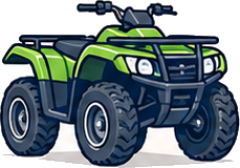
ATV

ATV Motorcycles

The term ATV stands for All-Terrain Vehicle. Originating in the late 1960s and 1970s as lightweight three-wheeled trikes aimed at accessing remote work sites, the platform evolved substantially due to stability considerations, establishing the modern four-wheeled format in the 1980s. Initially conceived to aid farmers, foresters, and remote workers traversing difficult landscapes, ATVs quickly broadened their scope. Today, they represent a versatile machine segment ranging from hardworking agricultural tools to agile, pure-recreation trail blazers.

Ergonomics, Controls, and Riding Dynamics

An ATV bridges the gap between motorcycle control interfaces and four-wheel vehicle chassis mechanics. The operator sits astride an open saddle, managing steering through a wide handlebar. Throttle input is predominantly delivered via a thumb-operated lever rather than a twist-grip, minimizing unintended throttle modulation across violent bumps.

  • Rider Posture: Upright seating with feet planted securely on wide floorboards or footpegs, allowing quick weight shifts.
  • Active Body Steering: Unlike single-track motorcycles that lean into corners automatically, an ATV stays flat. Riders must actively lean their body weight toward the inside of turns to prevent tip-overs and preserve traction.
  • Open-Air Architecture: Absence of doors and roll cages provides excellent visibility of ground hazards and immediate mounting or dismounting.

Core Characteristics of Modern ATVs

Regardless of whether a machine is built for heavy work or fast trail exploration, most ATVs share key engineering traits:

  1. High-Flotation Low-Pressure Tires: Knobby, large-volume tires operating at low psi absorb terrain shocks and prevent sinking into mud or sand.
  2. High-Travel Suspension: Independent suspension setups or solid rear axles allow individual wheels to articulate over severe obstacles.
  3. Versatile Drivetrains: Most modern utility models feature switchable 2WD/4WD systems paired with selectable differential locks and low-range gearing.
  4. Generous Ground Clearance: Raised frames and protected undercarriages allow vehicles to clear boulders, ruts, and fallen branches without high-centering.

What to Look for When Choosing an ATV

Selecting the right model depends on your planned operational environment. For agricultural tasks, property maintenance, or heavy hauling, prioritize utility platforms featuring steel cargo racks, receiver hitches, integrated winch mounts, and automatic CVT gearboxes with low range. For pure recreational agility on open dunes or closed tracks, lightweight sport ATVs with chain drive, manual transmissions, and adjustable shock absorbers are preferable. Engine displacement, cooling efficiency, and braking performance across wet terrain are crucial specifications to cross-reference.

Ideal Riders and Honest Limitations

ATVs are ideal for outdoor workers, property owners, search-and-rescue teams, and trail enthusiasts seeking reliable mechanical traction on unpaved landscapes. They suit riders who prefer not having to balance a two-wheeled dirt bike when stopped on slick inclines.

However, ATVs are not suited for highway commuting, high-speed asphalt transit, or riders expecting automotive luxuries such as weather-sealed cabins and climate control. On hard paved surfaces, their off-road tires and solid drivetrain characteristics lead to rapid tire wear and unpredictable turning behavior. Safe operation requires active physical exertion and dedicated off-road safety gear.

ATV Motorcycle Models

954 ATV motorcycles listed

A2 ATV 2011
  • Engine
    Single cylinder four-stroke
  • Power
    19.4 hp (14.3 kW)
  • Displacement
    493 cc
  • Bore/Stroke
    96.0mm / 82.0mm
A2 ATV 2011
  • Engine
    Single cylinder four-stroke
  • Power
    19.4 hp (14.3 kW)
  • Displacement
    493 cc
  • Bore/Stroke
    87.5mm / 82.0mm
A2 ATV 2011
  • Engine
    Single cylinder four-stroke
  • Power
    25.2 hp (18.5 kW)
  • Displacement
    401 cc
  • Bore/Stroke
A2 ATV 2011
  • Engine
    Single cylinder four-stroke
  • Power
    20.1 hp (14.8 kW)
  • Displacement
    278 cc
  • Bore/Stroke
    72.8mm / 66.8mm
A2 ATV 2011
  • Engine
    Single cylinder four-stroke
  • Power
    14.1 hp (10.4 kW)
  • Displacement
    244 cc
  • Bore/Stroke
    72.0mm / 60.0mm
A2 ATV 2011
  • Engine
    Single cylinder four-stroke
  • Power
    7.2 hp (5.3 kW)
  • Displacement
    150 cc
  • Bore/Stroke
    57.3mm / 58.0mm
ATV 2011
  • Engine
    Single cylinder four-stroke
  • Power
  • Displacement
    695 cc
  • Bore/Stroke
    102.0mm / 82.0mm
A2 ATV 2011
  • Engine
    Single cylinder four-stroke
  • Power
    19.4 hp (14.3 kW)
  • Displacement
    493 cc
  • Bore/Stroke
    87.5mm / 82.0mm
Triton ATV 2011
  • Engine
    In-line four four-stroke
  • Power
  • Displacement
    399 cc
  • Bore/Stroke
A2 Triton ATV 2011
  • Engine
    Single cylinder four-stroke
  • Power
    20.1 hp (14.8 kW)
  • Displacement
    280 cc
  • Bore/Stroke
    74.0mm / 65.2mm
A2 Triton ATV 2011
  • Engine
    In-line four four-stroke
  • Power
    37.5 hp (27.6 kW)
  • Displacement
    1,500 cc
  • Bore/Stroke
Triton ATV 2011
  • Engine
    Single cylinder four-stroke
  • Power
  • Displacement
    360 cc
  • Bore/Stroke
    78.0mm / 75.2mm
A2 Triton ATV 2011
  • Engine
    Single cylinder four-stroke
  • Power
    18.8 hp (13.8 kW)
  • Displacement
    280 cc
  • Bore/Stroke
    74.0mm / 65.2mm
A2 Triton ATV 2011
  • Engine
    Single cylinder four-stroke
  • Power
    20.1 hp (14.8 kW)
  • Displacement
    400 cc
  • Bore/Stroke
    78.0mm / 75.2mm
A2 Triton ATV 2011
  • Engine
    Single cylinder four-stroke
  • Power
    20.1 hp (14.8 kW)
  • Displacement
    400 cc
  • Bore/Stroke
    78.0mm / 75.2mm
A2 Triton ATV 2011
  • Engine
    Single cylinder four-stroke
  • Power
    18.8 hp (13.8 kW)
  • Displacement
    280 cc
  • Bore/Stroke
    74.0mm / 63.0mm
A2 Triton ATV 2011
  • Engine
    Single cylinder four-stroke
  • Power
    17.3 hp (12.7 kW)
  • Displacement
    250 cc
  • Bore/Stroke
    71.0mm / 63.0mm
Tomberlin ATV 2011
  • Engine
    V2 four-stroke
  • Power
  • Displacement
    552 cc
  • Bore/Stroke
    72.5mm / 66.8mm
Tomberlin ATV 2011
  • Engine
    Single cylinder four-stroke
  • Power
  • Displacement
    352 cc
  • Bore/Stroke
    80.0mm / 70.0mm
Tomberlin ATV 2011
  • Engine
    Single cylinder four-stroke
  • Power
  • Displacement
    276 cc
  • Bore/Stroke
    72.5mm / 66.8mm
Tomberlin ATV 2011
  • Engine
    Single cylinder four-stroke
  • Power
  • Displacement
    177 cc
  • Bore/Stroke
    82.5mm / 57.8mm
A2 Tomberlin ATV 2011
  • Engine
    Single cylinder four-stroke
  • Power
    8.8 hp (6.5 kW)
  • Displacement
    147 cc
  • Bore/Stroke
    57.0mm / 57.8mm
A2 TGB ATV 2011
  • Engine
    Single cylinder four-stroke
  • Power
    19.9 hp (14.6 kW)
  • Displacement
    503 cc
  • Bore/Stroke
    92.0mm / 75.6mm
A2 TGB ATV 2011
  • Engine
    Single cylinder four-stroke
  • Power
    41.0 hp (30.2 kW)
  • Displacement
    503 cc
  • Bore/Stroke
Sym ATV 2011
  • Engine
    Single cylinder four-stroke
  • Power
  • Displacement
    287 cc
  • Bore/Stroke
Sym ATV 2011
  • Engine
    Single cylinder four-stroke
  • Power
  • Displacement
    171 cc
  • Bore/Stroke
Suzuki ATV 2011
  • Engine
    Single cylinder four-stroke
  • Power
  • Displacement
    450 cc
  • Bore/Stroke
    95.5mm / 62.8mm
Suzuki ATV 2011
  • Engine
    Single cylinder four-stroke
  • Power
  • Displacement
    454 cc
  • Bore/Stroke
    84.0mm / 82.0mm
A1 Sachs ATV 2011
  • Engine
    Single cylinder four-stroke
  • Power
    6.3 hp (4.6 kW)
  • Displacement
    90 cc
  • Bore/Stroke
A1 Sachs ATV 2011
  • Engine
    Single cylinder four-stroke
  • Power
    8.8 hp (6.5 kW)
  • Displacement
    90 cc
  • Bore/Stroke
## Origins and Concept of the All-Terrain Vehicle The term ATV stands for All-Terrain Vehicle. Originating in the late 1960s and 1970s as lightweight three-wheeled trikes aimed at accessing remote work sites, the platform evolved substantially due to stability considerations, establishing the modern four-wheeled format in the 1980s. Initially conceived to aid farmers, foresters, and remote workers traversing difficult landscapes, ATVs quickly broadened their scope. Today, they represent a versatile machine segment ranging from hardworking agricultural tools to agile, pure-recreation trail blazers. ## Ergonomics, Controls, and Riding Dynamics An ATV bridges the gap between motorcycle control interfaces and four-wheel vehicle chassis mechanics. The operator sits astride an open saddle, managing steering through a wide handlebar. Throttle input is predominantly delivered via a thumb-operated lever rather than a twist-grip, minimizing unintended throttle modulation across violent bumps. - **Rider Posture:** Upright seating with feet planted securely on wide floorboards or footpegs, allowing quick weight shifts. - **Active Body Steering:** Unlike single-track motorcycles that lean into corners automatically, an ATV stays flat. Riders must actively lean their body weight toward the inside of turns to prevent tip-overs and preserve traction. - **Open-Air Architecture:** Absence of doors and roll cages provides excellent visibility of ground hazards and immediate mounting or dismounting. ## Core Characteristics of Modern ATVs Regardless of whether a machine is built for heavy work or fast trail exploration, most ATVs share key engineering traits: 1. **High-Flotation Low-Pressure Tires:** Knobby, large-volume tires operating at low psi absorb terrain shocks and prevent sinking into mud or sand. 2. **High-Travel Suspension:** Independent suspension setups or solid rear axles allow individual wheels to articulate over severe obstacles. 3. **Versatile Drivetrains:** Most modern utility models feature switchable 2WD/4WD systems paired with selectable differential locks and low-range gearing. 4. **Generous Ground Clearance:** Raised frames and protected undercarriages allow vehicles to clear boulders, ruts, and fallen branches without high-centering. ## What to Look for When Choosing an ATV Selecting the right model depends on your planned operational environment. For agricultural tasks, property maintenance, or heavy hauling, prioritize utility platforms featuring steel cargo racks, receiver hitches, integrated winch mounts, and automatic CVT gearboxes with low range. For pure recreational agility on open dunes or closed tracks, lightweight sport ATVs with chain drive, manual transmissions, and adjustable shock absorbers are preferable. Engine displacement, cooling efficiency, and braking performance across wet terrain are crucial specifications to cross-reference. ## Ideal Riders and Honest Limitations ATVs are ideal for outdoor workers, property owners, search-and-rescue teams, and trail enthusiasts seeking reliable mechanical traction on unpaved landscapes. They suit riders who prefer not having to balance a two-wheeled dirt bike when stopped on slick inclines. However, ATVs are not suited for highway commuting, high-speed asphalt transit, or riders expecting automotive luxuries such as weather-sealed cabins and climate control. On hard paved surfaces, their off-road tires and solid drivetrain characteristics lead to rapid tire wear and unpredictable turning behavior. Safe operation requires active physical exertion and dedicated off-road safety gear.

Frequently Asked Questions

What is an ATV?

An ATV (All-Terrain Vehicle) is an open-cockpit, four-wheeled motorized vehicle equipped with large low-pressure tires engineered specifically to traverse rugged unpaved surfaces.

Who should choose an ATV?

It is suited for rural property owners, agricultural and forestry workers needing hauling capability, and outdoor recreational riders exploring backcountry trails.

What are the key features of an ATV?

Major features include long-travel off-road suspension, generous ground clearance, selectable all-wheel-drive systems, and thumb-operated throttle controls.

Is an ATV suitable for beginners and what precautions should be taken?

While inherently stable at rest, ATVs require active body positioning to turn safely at speed; beginners should start on gentle terrain, avoid paved roads, and always wear appropriate protective gear.